Share:

Showing posts with label high ISO. Show all posts

Monday, May 23, 2016

View of the Milky Way with Your Naked Eye

Milky Way over The Watchman - Zion National Park, Utah. Light on mountain is light pollution from nearby Springdale city street lights ~ © Royce Bair

Simulated naked eye view
Histogram of a "naked eye" exposure
What the eye sees vs. what the camera sees. When people see my NightScapes for the first time the most common question is, "Is that what the Milky Way really looks like with your naked eye? Can you really see that many stars in the night sky?" The answer is, "Yes and no." You really can see it quite clearly with your naked eye (if you are in an area with very little light pollution), it's just not as bright as I can see with my camera.

The reason is because my camera is manually controlled to take the images at a longer exposure (typically 8 to 30 seconds, depending on the lens I'm using), so it gathers more light for its sensor than my eyes can. Also, the human eye has an iris aperture that is rated at about f/4.0, whereas my typical night photography lens is rated at f/2.8 or wider (letting in twice as much light to the sensor).

Histogram of raw camera exposure
Raw camera exposure
Above, is a simulated view of what my eye saw of the Milky Way over The Watchman in Zion National Park — this is about two stops darker than what my camera recorded (to the right), using an f/2.8 aperture setting, an exposure time of 15 seconds, and an ISO of 6400 or 8000. (Notice that the "toe" of the exposure histogram is just passing the midway point, whereas the toe of the simulated "naked eye" exposure histogram doesn't even come close to the midway point. This exposure is two stops less than what it should be —post production corrections can correct a 1-stop underexposure, but not a 2-stop underexposure. This means that if you only have an f/3.5 or f/4.0 lens; or your camera only goes to ISO 3200, you're still going to get an acceptable exposure, that's within the range of post production correction —provided you shoot in the camera "raw" mode, which typically has 16-bits of information, rather than the camera JPEG mode which carries only 8-bits of information per color channel. Here's a tutorial I created on the benefits of 16-bits raw images vs. 8-bits images.)

Post Production: The raw camera image has all the brightness and detail needed for a great photo, but it is flat or lacking in contrast. My final NightScape images are created in post production with very simple steps in Photoshop. All the stars are there in the camera's raw image, but a contrast gain in the sky is necessary to make them more apparent. My goal is give the same clarity you expect to see in an astronomical observatory (taken with a huge telescope) image, but with a wide-field view, coupled with an interesting landscape feature in the foreground — something the big telescopes cannot do!

After adding curve adj.
"S" shaped adjustment curve
The powerful "S" Curve. Here's the main Photoshop post production step I use to increase the contrast in the sky: I first select the sky, using the Magic Wand tool (I usually have to do a little Laso tool work to get all the bright stars into the selection). I then create a channel of the selection that I can use later. The second and main step is to turn that saved selection into a "Curves" Adjustment Layer that I can add a contrast-increasing "S" shaped adjustment curve. (The shape of this curve is controlled by the two anchor points so that the curve pinches or brightens the large highlight area to the right of the histogram "mountain", and darkens the shadow area to its left.) The more vertical the line becomes between the two anchor points, the more your contrast gain.

Slight color changes via Curves
Sky Color Balance. Every evening sky has a difference color to it, depending on the atmospheric conditions for that night. Some photographers shoot in the "AWB" Auto White Balance mode, which produces somewhat of a neutral coloration to the sky. Some will use a daylight White Balance (about 5250º K), giving a much warmer tone to the sky. Others will use the "Tungsten" (or incandescent) setting (about 3200º K) for a deep blue look. Although all of these settings can later be adjusted in Adobe Photoshop's RAW Converter, I prefer to set my Kelvin to 3800º. This setting usually give me the most natural look to my night sky.

Final, minor color changes can be made in Photoshop's Curves to the the red, green, and blue channels (represented by the three diagonal colored lines). Be careful to not over do this — as a little color goes a long way. The final coloration depends on what you remember seeing in the sky that night.

Adjusting the landscape. The final step is to use the same saved sky selection (channel) and inverse it so that it is now selecting the mountains, instead of the sky. Once this is done, another Adjustment Layer (you can use "Levels", or "Curves", but Curves is more powerful) is created from that selection in order to change the color of the sodium vapor lights (coming about a mile away from Springdale city) —so that The Watchman mountain is a more pleasing "red rock" sandstone color.

Histogram after all adjustments
Extended tonal range. The purpose of all these adjustments is to not only increase the contrast of the sky, but to extend the tonal range of the final image. Compare the histogram on the right to the histogram of the raw camera  exposure, above. Note: The "S" curve contrast adjustment naturally increases color saturation and vibrance. In most cases you will not have to artificially add more.

Compare: In the image below you can quickly compare the differences between the "naked eye" simulation, the "raw camera" exposure, the "S"-curve adjustment, and the final image —with the extended tonal range of its histogram.

Click to enlarge.
Here is another comparison of the camera RAW exposure vs. simple post processing via the "S" curve in a Photoshop "Curves" Adjustment Layer:

Click to enlarge
My eBook, Milky Way NightScapes, provides additional post processing instruction in its 4th chapter.


Friday, July 31, 2015

Canon’s New Camera shoots at ISO 4,000,000

Canon’s $30K ME20F-SH camera has a full-frame CMOS sensor and employs the EF mount system. 
The Canon ME20F-SH. Yesterday, Canon announced a two-megapixel camera (for 1920×1080 HD video at 60p, 24p, and 30p) with an ISO equivalency of 4 million. The camera has a price tag of $30 grand, and you’ll need to wait until December to buy it. Canon claims it’ll capture accurate colors with little to no noise in low light, or down to 0.0005 lux (for reference, that’s similar to a night with partial cloud cover and no moonlight). Nighttime surveillance and security, cinematic production, reality television, and nature/wildlife documentaries are just some of the ME20F-SH's many possible usage applications.

The camera's 35mm-sized full-frame CMOS sensor has pixels which are more than 5.5 times the surface area of the pixels on the CMOS sensors featured in top-of-the-line DSLRs like the 1D X. The modular body employs the same EF mount (Cinema Lock type) as Canon's SLR cameras and Cinema EOS System-series of professional digital cameras, allowing users to make use of the Company's extensive lineup of interchangeable EF lenses.

Canon’s ME20F-SH did not suddenly come forth out of the blue. We announced it’s prototype back in 2013. Here’s a video of results from the 2013 camera and video results from the new sensor.

The big question for still photographers, is whether some of this low-light capability will filter down to Canon’s DSLR cameras. It may already have. Rumor has it that the upcoming Canon EOS 5D Mark IV may have an ISO range of 100-204800 ISO compared to the Mark III’s current range of 100-25600 ISO — a four-stop gain. Although the Nikon D4s and the Sony A7s are already touting ISOs of 409600, it will be interesting to see how low the noise/sharpness is at these ISOs when all three cameras are compared together. “NightScape” style photographers who currently use the Sony A7s tell me that they typically shoot at ISO 12800 and are not bothered by the noise. Their real joy comes from being able to do live view composition and focus (at ISO 409600) — the camera can literally see in the dark!


Tuesday, April 9, 2013

Canon 6D is the Low Light Winner Over Nikon D600

In high ISO video tests, the Nikon D600 was at least 2-stops behind the Canon 6D. © Michael Andrew
Early reviews were a disappointment to many Canon users: Both cameras are entry-level, full-frame sensor cameras in the $2,000 price range. When the Canon EOS 6D finally came out in December 2012, following the Nikon D600's flashy entry in September 2012, many Canon users were somewhat disappointed. The Canon has fewer mega pixels: 20MP verses the Nikon's 24MP. It has only 11 focusing squares verses the Nikon's 39. The Nikon has a built-in flash, and the Canon does not. The Canon shoots at 4.5 frames per second in burst mode compared to Nikon's 5.5 frames/second. The Nikon can do focus tracking in live view, but the Canon cannot. Nikon has a wireless transmitter and a headphone jack, and the Canon does not. The Nikon's shutter is duty-rated at 150K cycles, whereas the Canon is only rated at 100K cycles. The Canon does have a cool Wi-Fi tethering feature though, that the Nikon does not.

Specs on paper don't always translate to real world shooting experiences: Michael Andrew has recently produced a YouTube video that provides one of the best and most unbiased field reviews of these two cameras I have seen. It's called the, "Nikon D600 vs Canon 6D Epic Shootout Comparison". Michael concludes that the Nikon D600 is still a slightly better all-around full-frame camera than the Canon 6D, but not by as much as some had suspected.

At high ISOs, the Nikon D600 often exhibits excessive noise in the shadow areas. © Michael Andrew
Low Light Leader: What will surprise many is how much better the Canon 6D performs in low light over the Nikon D600. Michael concludes that "…the Canon 6D is outstanding in its low light focusing and its high ISO noise …the Canon 6D is at least 2-stops better than the Nikon D600 [in its handling of high ISO noise for video] …the Nikon D600 peaked out a little before ISO 3200, whereas the Canon looks pretty phenomenal even at ISO 12,800—and in some cases even ISO 25,600."

High ISO JPEGs and RAW images: In still photos, Michael concluded that, "...the Canon 6D is 1-2 stops better in reproducing high ISO images than the Nikon D600, depending on the subject and file type."

The Canon 6D's high ISO JPEG performance was about 1 to 2 stops better than the Nikon D600. © Michael Andrew
How does the Canon 6D compare to the Canon 5D Mark III? The observations of this editor indicate that for still photos, the Canon 6D and 5D Mark III sensors perform very similarly. The $1,500 savings between the two cameras should be quite attractive to the entry-level photographer looking to find a great full-frame camera for high ISO night photography.

However, Michael Andrew points out in his review that there is a reason the Mark III has a very good reputation for professional quality video. His test showed that the Mark III handled aliasing and moire much better than the other two cameras. In his conclusion, the Nikon D600 had the best dynamic range. It's weaknesses were high ISO noise, moire, and aliasing. The Canon 6D had the best quality in high ISO noise (almost identical to the Mark III). Its weaknesses were in aliasing and moire. The Canon 5D Mark III had the least aliasing and moire, and was similar to the 6D in good quality high ISO noise. Its weakness is its high price (about $3,500).

Michael Andrew (aka Michael the Maven) has great "Crash Course" training videos on many camera models at his popular blog.

Use promo code "nightcape" to save 20% off premium stock photography at prime.500px.com
Advertisement: Hot Weekly Photography Deals - Amazing discounts (updated twice a week).

Monday, October 15, 2012

Nikon D3s: Best Ever High ISO Camera?

Cairo & Alexandria, Egypt at night ~ taken with the Nikon D3s • 16mm lens • f/2.8 • 1/4 sec. • ISO 51,200
I am one of many photographers who believe the Nikon D3s may be the best high ISO camera ever made for night photography work, especially in its day. It set a benchmark that others have sought to achieve. And, I say this even though I'm currently a Canon EOS 5D Mark III user.

The above NASA photo, taken on 28 October 2010 from the International Station Science, is a good example of the amazing high ISO capabilities of the Nikon D3s. The Nile River and its delta stand out clearly. On the horizon, the airglow of the atmosphere is seen across the Mediterranean. Although a full resolution view of this image shows it to be a noisy photo (at ISO 51200), the image would not have even existed without the technology of the Nikon D3s. (My Canon EOS 5D Mark II had a maximum ISO of 25600, but even at that speed it would have been much noisier than the Nikon at ISO 51200.)

Nikon D3s
James Neeley mentioned in a recent blog post that he felt the Nikon D3s still had a slight edge over the newer Nikon D4. This is mainly because of the huge size of the pixels in the 12.1MP D3s sensor, compared to smaller pixels in the D4, D800, and D600 sensors. Despite the newer sensor technology, Sony (who makes the chips for Nikon) has still not been able to quite overcome the benefit that comes from bigger pixels, although it is getting very close. Today, there are at least half a dozen full-frame sensor DSLR cameras that rival the high ISO capabilities of the D3s, and saying which is the best for night photography is like splitting hairs!

Saturday, September 29, 2012

New Entry-level Full-frame Cameras Lower the Cost for High ISO Night Photography

Delicate Arch by Florian Schultz ~ taken with the Nikon D600 @ ISO 3200
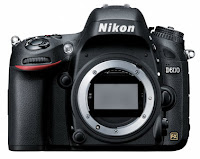
Nikon D600
Canon EOS 6D
Nikon and Canon recently announced two new entry-level, full-frame DSLR cameras that will significantly lower the cost for photographers wanting to enter into the field of doing quality, high ISO night photography. Both the Nikon D600 (released on September 13, 2012) and the Canon EOS 6D (to be released in December 2012) are priced in the U.S.A. at about $2,100. This makes the Nikon D600 about $900 less than the popular D800, and the Canon EOS 6D about $1,400 less than the 5D Mark III. Full-frame image sensors typically produce less image noise than smaller sensors because each pixel in the sensor array is larger and can capture more light, producing a lower signal-to-noise ratio.

Nikon D600 Sensor is Comparable to the D800: The Nikon D600 has a new 24.3-megapixel FX-format CMOS sensor. Nikon says the camera's 14-bit A/D conversion and excellent signal-to-noise ratio enable it to produce images with low noise and wide dynamic range even at high ISO sensitivities. The D600 offers an ISO range of 100–6400, extendable up to 25,600. Recent tests by DXO Labs rate the Nikon D600's sensor higher than the Nikon D3X, Nikon D4, Canon EOS 5D Mark III, and only slightly less than the Nikon D800! It will be interesting to see how well the Canon EOS 6D performs in these same tests after its release in December. (I agree with DxO's conclusion about the D600's sensor performing just slightly below the D800, but I'm not sure I agree that both sensors perform better than the Canon 5D Mark III. This leads me to the belief that the Canon 6D sensor may actually perform better than the Nikon D600 when all the tests are in (see below)).

This shows cropped detail of the top photo (click for an enlargement at 100%)
Examine the Results for Yourself: This Nikon D600 photo was taken using a AF-S NIKKOR 14-24mm f/2.8G ED lens (zoomed to 15mm). The exposure was for 25 seconds @ f/2.8, ISO 3200, with the white balance color temperature set at 3,030 K. This image was taken in RAW and converted to JPEG with Capture NX 2 (you can download the 11.5 MB JPEG here). Note: the arch may appear soft (lacking in texture and detail), and that's probably because it is slightly out of focus, since the focus is set on infinity for the stars, and the f/2.8 aperture setting allows for very little depth of focus. Still, the sky has relatively little noise for an ISO of 3200! (Click here to see other sample images from the Nikon D600.)

Nikon D600 VIDEO: Photographer, Florian Schultz, and his brother, Salomon, share their experiences of testing the new Nikon D600 in a video called, "Chasing the Light" --shot entirely with the D600. Be sure to also see, "The Making of Chasing the Light" --two brothers on a road trip, in an old pick-up truck! (I was intrigued to learn that the D600 has a built-in intervalometer, and also has the ability to preview time lapse shots as a video sequence!)

Nikon D600 Preview: For the best hands-on preview go to this Digital Photograpy Review.

Canon EOS 6D Preview: Because the 6D will not be released until December, there is little information available about it at the moment. For the best hands-on preview of the Canon EOS 6D, with key specs compared to the Canon EOS 5D Mark III and Nikon D600, go to this Digital Photograpy Review.

Lens Compatibility: If you are currently using a Canon camera with an APS-C size sensor and LF-S lenses, you'll also have to upgrade to LF lenses, since the LF-S lenses do not provide full-frame sensor coverage. However, the Nikon D600 FX-format camera does offers support for the complete DX NIKKOR lens lineup (with DX lenses, the camera automatically switches to a 10.5MP DX-format crop mode). One must use FX NIKKOR lenses to take advantage of the camera's full 24.3-million pixels.

My Opinion: Overall, there are several specification on the Nikon side that out-weigh the Canon specs. However, this blog is about night photography and the benefits of low noise at high ISO's.  I think either camera is going to be a smash hit for photographers wanting the higher dynamic range and lower noise of a full-frame sensor. Although the Nikon is the first entry-level full-frame camera out of the gate and with a lot of hype, I think time may show that the image quality of the Canon EOS 6D to be superior at higher ISO's. There are at least two factors that lead me to this belief:
Number One: The default standard ISO range on the Nikon D600 is 100 to 6400, whereas the Canon EOS 6D has a standard ISO range of 100 to 25600, which is two stops greater. This would indicate that the Canon has superior noise control and a higher real life dynamic range.
Number Two: Tests from other sources lead me to believe that the DxOMark Sensor Scores may not be totally reliable (as several others have commented on the DxO website). For instance, they give an overall sensor score of 94 to the Nikon D600, just one point below the Nikon D800's score of 95; and they give the Canon EOS 5D Mark III a dismal score of 81, just two points above the older Mark II's score of 79.
Test pattern at Digital Photography Review (I choose the "BA" area from the bottle of Baileys liquor)
The best comparison test I've found comes from Digital Photography Review. When you take their test chart and compare the original Nikon D600 image file @ ISO 100 with three other images taken at ISO 6400, you'll notice that the Canon EOS 5D Mark III is closer to the ISO 100 image than the other two, followed by the Nikon D800, with the Nikon D600 coming in last. Both the chroma and the luminance noise are higher in the Nikon images, especially in the shadow areas (some would say the D800 chroma noise is worse than the D600). Yet DxO rates both camera sensors considerably higher than the Mark III. It is my opinion that the Canon EOS 6D sensor will be close to the same quality as the Mark III sensor (just as the D600 is close the quality of the D800), and will therefore surpass the sensor quality of the Nikon D600. (Click to enlarge the image below.)
Choose any 3 cameras you want to compare. I chose these and an ISO of 6400 (top left is the ISO 100 control)
Another Indicator To My Above Conclusion: The size of the above JPEG files also indicate the noise quality of the images. We all know that noisier files do not compress as well (lower compression rates). For instance, the Nikon D600 JPEG control image (at ISO 100) is 11.0MB, compared to 14.5MB for the ISO 6400 JPEG file. If you do the numbers below, you can see that the Mark III has the least noise, (because its JPEG file has the highest compression rate), followed by the D800, with the D600 trailing dead last:

   CAMERA FILE        PIXEL SIZE       UNCOMPRESSED / COMPRESSED      COMPRESSION RATIO
   Canon 5D Mk3 file: 5760 x 3840 pixels =  63.28MB /  8.4MB JPEG  =  7.53:1 compression
   Nikon D800 file:   7360 x 4912 pixels = 103.43MB / 18.8MB JPEG  =  5.50:1 compression
   Nikon D600 file:   6016 x 4016 pixels =  69.12MB / 14.5MB JPEG  =  4.77:1 compression