 |
| "November Moon" - Hocking Hills, Ohio ~ © Jim Crotty (click for a larger view) |
This image is a double exposure, combining the Moon captured with the 500mm, and the foreground captured with a 70-200mm (however, Jim never places the Moon away from its original location in the scene). This photo was captured on a Thanksgiving evening at one of his favorite locations for landscape photography, Hocking Hills State Park in Southeastern Ohio. This particular hill was behind The Inn at Cedar Falls, where Jim now returns twice each year to teach weekend workshops. For Jim, this image captures the spirit of the area of Hocking Hills. "There is something deeply personal for me as an artist that I connect with in this place. Perhaps it's because Hocking Hills is where I first discovered my love for nature photography when I was about 13 years old."
"It's all about the light," says Jim Crotty. "I'm really more of a twilight/pre-dawn type of photographer... Although I admire the work of deep and dark sky photographers, I tend to limit myself to lunar, particularly when I can include a landscape as foreground."
Philosophically Speaking: Jim likes the challenges of night and lunar photography. "Obtaining detail and proper exposure for night sky subjects isn't exactly something anyone can do simply by picking up a point-n-shoot camera and putting it on auto. It takes skill and experience. When everything comes together it can be extremely rewarding. Nightfall and dawn are those in-between spaces where capturing images is part art and part spiritual journey. The Moon and moonlight has a way of speaking to the poet that resides in all of us. Night sky subjects reveal the enormity and wonder of the universe, in space and within us."
 |
| "The Rising" - Dawn and crescent moon from Dayton, Ohio ~ © Jim Crotty (click for a larger view) |
This photo was captured at dawn from behind Jim's home, which at that time was in Centerville, Ohio, just south of Dayton. This is a double exposure; the foreground captured with a Canon 70-200mm f4 L IS lens and the Moon with a 300mm f4 L IS and 1.4 teleconverter. Most of Jim's Moon images are captured just after sunset but this is one of the few taken just before sunrise. The clarity of that morning provided an amazing hue to the pre-dawn sky. "I [am] frequently up early to photograph sunrise scenes, especially during summer. It [is] in the quietness of those moments when I truly [feel] at peace."
The Challenges: Light pollution. Jim is often amazed at how much of an impact a few street lights can have on clarity in the sky. Finding a good evening location to shoot from can also be challenging from the standpoint of not being interrupted, and of safety. The public access points to the beach on Hilton Head (South Carolina) are not as safe as daytime (when you are carrying expensive photographic equipment), which is a shame, because the darkest sky is found over the ocean.
Bugs and sand. Just after sunset and right before sunrise the bugs can be horrible too, especially in sub-tropical coastal areas like Hilton Head. He has been eaten-up pretty bad by sand fleas. Shooting on the beach can also be very rough on gear. Jim has already had a Canon 28-70mm f2.8 L lens trashed due to sand.
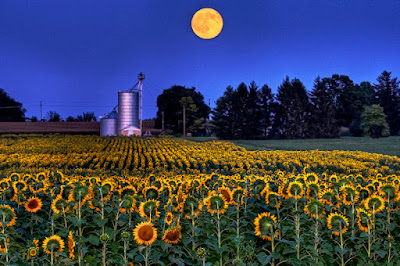 |
| "Moonflowers" - Sunflower field and August Moonrise in Greene County, Ohio ~ © Jim Crotty |
This single exposure image was completely unplanned. "I had captured a series of images on the other side of the road, ...with the sun setting behind the sunflowers," says Jim. "As I was putting my gear back in my truck, I looked to the other side and there was the August full Moon rising. With the light of dusk still falling on the flowers I was able to capture several exposures before the Moon rose too high and the last light of dusk was gone."
Favorite equipment: His tripod and the Kirk ballhead Jim purchased over 12 years ago. The ballhead still works like new—it is one of the best gear investments he has made, next to camera bodies and lenses. It has outlasted two tripods! His favorite lens for Moon photography is his Canon 500mm f4.5 telephoto, although it's a heavy piece of glass. Jim bought it used about eight years ago, and it's been flawless.
Software: Jim relies on the Sun n Moon iPad app for helping to plan his shots. For initial post editing and file management, he uses Aperture. He's also a big fan of the Nik plug-ins, particularly, Color Efex 4 and Viveza 2.
 |
| "On the Tides of Easter" - full Moon rising over Hilton Head Island, South Carolina ~ © Jim Crotty |
Both the Moon and the foreground of this image were captured using a Canon 1D Mark III camera. The foreground was captured with a Canon 70-200mm EF L lens at 70mm, RAW capture, aperture priority mode, one stop under exposed at 2000 ISO f/5.6, 0.5 seconds. The Moon was captured with a Canon 500mm f4.5 EF L lens at ISO 800, f/4.5, 1/50 second, aperture priority mode, -3.0 EV. The Moon and foreground images were combined in post.
The images were captured at high tide on the evening of Good Friday, April 6, 2012. This photo works because the waves were at high tide. "It's an entirely different dynamic than low tide," says Jim. "There is something so magical about a moonrise over the ocean. It's mystical and primordial at the same time. Although I try not to make it obvious, there is always a subtle nod to my own spirituality and reverence for God's creation in my images. Where I am at now with my photography is in large part a spiritual journey, which became more prevalent in all that I do following a few life changing events, including divorce in 2008 and then a heart attack in 2010. There is a deep desire within me to share my photography as proof of a divine connection between artist and subject and audience. I'm convinced that with nature's beauty we are provided signs and hints of something so much more than what is immediately before us. The photographer can serve as witness in helping others to stop and take notice."
Early History: "Astrophotography was the door that opened the world of photography for me at a very young age," says Jim. "I loved astronomy growing up in Ohio. I had telescopes early on and was always out observing. I think my first scope was a four and half inch reflector, when I was about 10 or 11, back in the 70's."
It was also about that time that Jim started exploring nature subjects with a Pentax Spotmatic F 35mm SLR camera. For him, there was nothing more exciting than shooting time exposures of the night sky on Kodak Tri-X black and white film and then developing and making prints in his darkroom. He is very thankful for the adult mentors back then who helped him learn and encouraged his interest in both astronomy and photography. Jim tries his best to "play it forward" when he teaches young photographers in his workshops.
 |
| Jim Crotty |
Currently: Jim teaches photography workshops, provides commercial photography services and sells fine art prints of his award-winning work with nature and landscape subjects. His images have been published in
Nature's Best,
National Wildlife,
Smithsonian,
USAToday, and most recently, the
Professional Photographer Magazine. In 2009 he earned the professional designation of Certified Professional Photographer through the Professional Photographers of America. Today he works from a home office and studio located in Frisco, Texas having recently relocated from Hilton Head Island, South Carolina.
More of Jim
's work can be found at his website:
Fine Art Photography and Photography Services by Jim Crotty, and at his
Facebook page.
Advertisement: Hot Weekly Photography Deals - Amazing discounts (updated twice a week).


