Share:

Showing posts with label moon photography. Show all posts

Wednesday, August 26, 2015

How to make Saturday’s Supermoon shine in your photos

Nikon D7100 • 500mm • f/5.0 • 1s • ISO 400 • 5400K • 6/13/14 09:41pm
Sun elevation: -5.1° (Blue Hour) • Moon elevation: 1.3°
Antoni Cladera has written an article (All You Need To Make This Saturday’s Supermoon Shine In Your Photos) on the PhotoPills blog to help you take advantage of this Saturday’s Supermoon event.

“This Saturday, August 29th 2015, the full moon will be at 'only' 358,981km from Earth. This gives us the opportunity to enjoy and shoot what is commonly known as a Supermoon.

"Note that in Asia and Australia the full moon is happening on Sunday, August 30th, because of the different time zone. Then, check the day of the full moon in your local time. It should be on the 29th or the 30th.

"With an angular diameter of 0.556°, the full moon will look slightly larger in our photos. Get ready to take advantage of it!

"How? Location power, inspiration, equipment and the following tips are the ingredients you need to have in the mix in order to come up with the best cocktail for the Supermoon.

"It all begins by deciding how big you want the moon in your photos. Let’s decide the focal length we are going to use.”

Antoni lays out the the following ideas and suggestions, complete with illustrated, step-by-step instructions:
  1. Focal length defines how big the moon will appear in the photo
  2. Go to a location with an interesting subject, a beautiful landscape and space to move
  3. The shooting spot determines the size of the moon relative to your subject
  4. The idea, your imagination makes the difference
  5. The plan: finding the right shooting time and the right shooting spot
  6. How to shoot the Supermoon
  7. Just do it!
Be sure to view the complete article for all the details.


Thursday, April 17, 2014

Moon over Delicate Arch by Steve Waterman

Moon over light-painted Delicate Arch, Arches National Park ~ © Steven T. Waterman
Steve Waterman took our Photo of the Day with a Nikon D800, using a Nikkor 14-24mm f/2.8 lens (at 24mm) • f/2.8 • 8 sec • ISO 1600. Light painting was done by Chris Bair at a September 2013 NightScape Workshop.

"Storm clouds were a challenge that night," says Steve. "We were waiting for the moon to set, to permit images of the Milky Way.  The challenge was getting sufficient exposure of Delicate Arch without the moon blowing out the picture."

Steve Waterman shares photography for fun and relaxation with his wife, Denise.  To support the photography hobby, he practices law, doing commercial litigation and reorganization with an international law firm. (The above photo was used on the firm's annual Christmas card.)


Royce's 2014 Workshop, Lecture & Video Conference Schedule: NightScapeEvents.com


Monday, January 6, 2014

Moon Burst at Sunburst Peak by Mei Xu

"Moon Burst at Sunburst Peak" (Mt. Assiniboine Provincial Park, Canada) ~ © Mei Xu (click to enlarge)
Mei Xu supplied our Photo of the Day. It was taken with a Nikon D700, using a 17-35mm f/2.8 lens. She blended two images. The mountain was photographed using an exposure of f/16, 20 seconds, at ISO 200. The night sky exposure was f/2.8, 6 seconds, at ISO 1600. The images were processed and blended using Lightroom and Photoshop.

Mei currently lives in Colorado. When she is traveling, hiking and skiing, the camera is her third eye to explore the wonder of the world and to capture the beauty of the nature. She finds this type of night photography challenging because it requires one to shoot images at different times in order to reduce noise and compress the contrast ratio into an image that can be seen photographically. "There are tons of beautiful images about Mt. Assiniboine. I think mine is different than others. It is unique with the moon and beautiful texture of the clouds," says Mei.

More of Mei's work can be seen on her website and her 500px 'Mengzhonghua' page.

Royce's 2014 Workshop, Lecture & Video Conference Schedule: NightScapeEvents.com
   -  25% OFF savings on select "IMAGE10" workshops booked before April 1, 2014  -


Wednesday, December 11, 2013

Twilight Road Thru the Alabama Hills by Miles Morgan

"The Polarizer" ~ © Miles Morgan
(click to enlarge - then click large image again, to view on black)
Miles Morgan photographed this scene with a Nikon D800E, using a 35mm focal length lens. Exposure was 60 seconds @ f/13, ISO 100 (the moon was a separate exposure with a 70mm lens —but it was in that position over the Sierras). Miles Morgan is an airline pilot out of Portland, Oregon who doubles as an amateur fine art landscape photographer. More of Miles' work can be seen on his 500px page and his website.

I'll let Miles tell the rest of the story in his own words:

Ask around. I'm Mr. Clear Skies lately. I have more sucking removal power than a Hoover vacuum. This makes me grumpy, so it is no small feat that buddies David "Breezy" Thompson and Paul Rojas have been able to put up with me for several photo trips these past few months. We finally did manage a few clouds, but we spent many days trying to come up with shots that would work in the clear blue, and with the full moon hanging around, even night images were proving to be taxing.

I bombed down from Washington to the Mono Lake the first day, and arrived in time for a... you guessed it.... clear sunset. With the full moon rising, however, I figured that I might be able to sneak out some sort of image. I hustled down to the lakeshore and came to a screeching halt. There must have been 100 photographers scrambling around, over, and through the tufas. My camera stayed in the bag.

The Econo Lodge in Mammoth Lakes seemed like a logical place to crash out for a few hours before sunrise, but around 3am I decided that I simply wasn't going to be able to rest, so I might as well head out and find something to shoot. I popped out into the bitter night air, and turned behind a Suburban to head towards my rig only to discover some families tailgate wide open, and trash strewn all over the parking lot. I now found myself face to face with a bear twice my size, who was getting intimate with a Twinkie. I couldn't think of much to do, so I said "Hello". Luckily, I've lost a few pounds recently, so the Twinkie looked a little creamier, I guess, because he went back to eating and ignored me completely. I continued down the lot to my car, and drove off as if nothing could be more normal.

Arriving at Alabama Hills the next day, I finally had enough time to scout out some compositions that might work while I waited for "the boyz" to arrive. With the Photographers Ephemeris, I knew where the moon would set, and that it would be hanging over the mountains in the blue hour before dawn, so I set about finding a composition that might work for the expected conditions the next morning. You guessed it.... clear. Dawn came, and the three of us hustled out to some spots we had found the evening before to shoot. Nothing was working so I came back to this area that I had considered the day before, and set to work. Getting the exposure right, jumping in Rico, my trusty steed, and driving back and forth trying to make this work before the moon disappeared behind the hills was a right challenge in the nippy morning air, but it finally came together. Only it didn't. The moon looked too small, and to expose for the land areas correctly required the moon to be blown totally. I opted to simply zoom in, fire off a shot at 70mm and exposed for the moon itself in order to present it as it appeared to my eyes. A purist, I ain't.

So the title. No I didn't use a polarizer. It's in response to the reaction that I received regarding this image from my critique group, which consists of several photographers who are WAY better than me, and who do me the solid of giving me their honest impression of what works, what doesn't, and what I can do to improve it. This shot simply didn't work for many of those folks. Ironically, it ended up being my favorite from the trip, proving once again I have questionable taste at best. I love that paradox about photography.

Editor's Note: Here's another great Alabama Hills nightscape by Miles. Unlike the "zoo" of photographers that can form around the Mono Lake area, the Alabama Hills continues to be much less crowded, yet it offers amazing photographic opportunities and clear, dark nights for some of the best astro-landscape photography in the world. I will be conducting a NightScape Workshop in the Alabama Hills, April 22-25, 2014.

Royce's 2014 Workshop, Lecture & Video Conference Schedule: NightScapeEvents.com
Featured Post: Shooting Stars eBook Review — How to Photograph the Stars and the Moon

Monday, October 28, 2013

Shooting the October Moon - Mike Jackson

Alpen Glow Over Cunningham Cabin ~ © Mike R. Jackson 2010
My friend, Mike Jackson, recently posted on his Best of the Tetons blog some "Tips for Being at the Right Place at the Right Time" when photographing the October moon (or the moon in any month for that matter). If you like Grand Teton National Park, you'll enjoy Mike's blog, because it provides one of the most comprehensive photographic studies of this area, along with some great tips. Mike and his wife have lived in Northwestern Wyoming for over 26 years, during which time he has photographed almost every location in the area worthy of a camera lens. Although his blog started just this year, he is posting new locations and photos each week, so this site should soon become a great reference for travelers to the area.

Moon Over Grand Teton ~ © Mike R. Jackson 2013
Yellowstone Falls from Artist Point ~ © Mike R. Jackson 2011
More of Mike Jackson's work can be found at his website, Teton Images.


Royce's 2014 Workshop, Lecture & Video Conference Schedule: NightScapeEvents.com
Featured Post: Shooting Stars eBook Review — How to Photograph the Stars and the Moon

Monday, September 2, 2013

Sacred Moon by Steven Sharp

Moon over Oquirrh Mountain Utah Temple ~ by Steven Sharp (click to enlarge)
I just returned last week from conducting a very enjoyable NightScape workshop in Bryce Canyon National Park. It's fun to get to know each attendee: how they interpret each location, and to review some of their past work. On the last day of each workshop we typically have a show-n-tell. We not only review some of our favorite shots from the workshop, but each participant is also encouraged to show a few photos from their portfolio. This moonscape by Steven Sharp caught my attention because its high dynamic range.

After talking with Steven, I learned that he had indeed employed HDR techniques to capture this very contrasty night scene. After shooting three exposures in rapid secession (the typical 2 stops under, 2 stops over, and proper exposure), Steve used Photomatix Pro to combine the images. Screen captures, histograms, and metadata for the three images are supplied below (click to enlarge).


When I first looked at the image, I felt the composition could be improved with a vertical crop, but I then discovered Steven had taken the photo for a calendar contest featuring local LDS (Mormon) temples; and I realized the reason for the horizontal composition. This photo was chosen for the month of October 2014.

Steven has only been into serious picture-taking for a little over two years! "I started into photography when my oldest son, who wanted to settle a debt but didn't have cash, gave me a Nikon D80 and three lenses as payment," says Steven. "I knew nothing about photography, especially with a DSLR, but was excited to have a cool camera: look at all those buttons and settings to learn about! I [now] carry my camera and tripod with me almost everywhere I go. I've found that taking pictures is one of the best ways to learn how to take pictures. I'm having a blast making mistakes as I learn about photography. The learning never stops and neither does the fun!"

More of Steven's photography can be seen at his website, including his most recent photos taken at Bryce Canyon NP.


Thursday, March 21, 2013

The Twilight / Moon Photography of Jim Crotty

"November Moon" - Hocking Hills, Ohio ~ © Jim Crotty (click for a larger view)
This image is a double exposure, combining the Moon captured with the 500mm, and the foreground captured with a 70-200mm (however, Jim never places the Moon away from its original location in the scene). This photo was captured on a Thanksgiving evening at one of his favorite locations for landscape photography, Hocking Hills State Park in Southeastern Ohio. This particular hill was behind The Inn at Cedar Falls, where Jim now returns twice each year to teach weekend workshops. For Jim, this image captures the spirit of the area of Hocking Hills. "There is something deeply personal for me as an artist that I connect with in this place. Perhaps it's because Hocking Hills is where I first discovered my love for nature photography when I was about 13 years old."

"It's all about the light," says Jim Crotty. "I'm really more of a twilight/pre-dawn type of photographer... Although I admire the work of deep and dark sky photographers, I tend to limit myself to lunar, particularly when I can include a landscape as foreground."

Philosophically Speaking: Jim likes the challenges of night and lunar photography. "Obtaining detail and proper exposure for night sky subjects isn't exactly something anyone can do simply by picking up a point-n-shoot camera and putting it on auto. It takes skill and experience. When everything comes together it can be extremely rewarding. Nightfall and dawn are those in-between spaces where capturing images is part art and part spiritual journey. The Moon and moonlight has a way of speaking to the poet that resides in all of us. Night sky subjects reveal the enormity and wonder of the universe, in space and within us."

"The Rising" - Dawn and crescent moon from Dayton, Ohio ~ © Jim Crotty (click for a larger view)
This photo was captured at dawn from behind Jim's home, which at that time  was in Centerville, Ohio, just south of Dayton. This is a double exposure; the foreground captured with a Canon 70-200mm f4 L IS lens and the Moon with a 300mm f4 L IS and 1.4 teleconverter. Most of Jim's Moon images are captured just after sunset but this is one of the few taken just before sunrise. The clarity of that morning provided an amazing hue to the pre-dawn sky. "I [am] frequently up early to photograph sunrise scenes, especially during summer. It [is] in the quietness of those moments when I truly [feel] at peace."

The Challenges: Light pollution. Jim is often amazed at how much of an impact a few street lights can have on clarity in the sky. Finding a good evening location to shoot from can also be challenging from the standpoint of not being interrupted, and of safety. The public access points to the beach on Hilton Head (South Carolina) are not as safe as daytime (when you are carrying expensive photographic equipment), which is a shame, because the darkest sky is found over the ocean.

Bugs and sand. Just after sunset and right before sunrise the bugs can be horrible too, especially in sub-tropical coastal areas like Hilton Head. He has been eaten-up pretty bad by sand fleas. Shooting on the beach can also be very rough on gear. Jim has already had a Canon 28-70mm f2.8 L lens trashed due to sand.
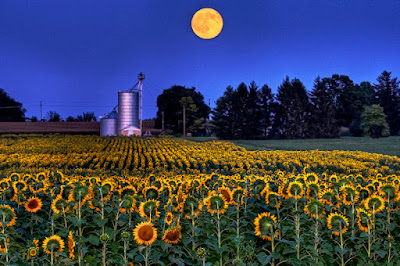
"Moonflowers" - Sunflower field and August Moonrise in Greene County, Ohio ~ © Jim Crotty
This single exposure image was completely unplanned. "I had captured a series of images on the other side of the road, ...with the sun setting behind the sunflowers," says Jim. "As I was putting my gear back in my truck, I looked to the other side and there was the August full Moon rising. With the light of dusk still falling on the flowers I was able to capture several exposures before the Moon rose too high and the last light of dusk was gone."

Favorite equipment: His tripod and the Kirk ballhead Jim purchased over 12 years ago. The ballhead still works like new—it is one of the best gear investments he has made, next to camera bodies and lenses. It has outlasted two tripods! His favorite lens for Moon photography is his Canon 500mm f4.5 telephoto, although it's a heavy piece of glass. Jim bought it used about eight years ago, and it's been flawless.

Software: Jim relies on the Sun n Moon iPad app for helping to plan his shots. For initial post editing and file management, he uses Aperture. He's also a big fan of the Nik plug-ins, particularly, Color Efex 4 and Viveza 2.

"On the Tides of Easter" - full Moon rising over Hilton Head Island, South Carolina ~ © Jim Crotty
Both the Moon and the foreground of this image were captured using a Canon 1D Mark III camera. The foreground was captured with a Canon 70-200mm EF L lens at 70mm, RAW capture, aperture priority mode, one stop under exposed at 2000 ISO f/5.6, 0.5 seconds. The Moon was captured with a Canon 500mm f4.5 EF L lens at ISO 800, f/4.5, 1/50 second, aperture priority mode, -3.0 EV. The Moon and foreground images were combined in post.

The images were captured at high tide on the evening of Good Friday, April 6, 2012. This photo works because the waves were at high tide. "It's an entirely different dynamic than low tide," says Jim. "There is something so magical about a moonrise over the ocean. It's mystical and primordial at the same time. Although I try not to make it obvious, there is always a subtle nod to my own spirituality and reverence for God's creation in my images. Where I am at now with my photography is in large part a spiritual journey, which became more prevalent in all that I do following a few life changing events, including divorce in 2008 and then a heart attack in 2010. There is a deep desire within me to share my photography as proof of a divine connection between artist and subject and audience. I'm convinced that with nature's beauty we are provided signs and hints of something so much more than what is immediately before us. The photographer can serve as witness in helping others to stop and take notice."

Early History: "Astrophotography was the door that opened the world of photography for me at a very young age," says Jim. "I loved astronomy growing up in Ohio. I had telescopes early on and was always out observing. I think my first scope was a four and half inch reflector, when I was about 10 or 11, back in the 70's."

It was also about that time that Jim started exploring nature subjects with a Pentax Spotmatic F 35mm SLR camera. For him, there was nothing more exciting than shooting time exposures of the night sky on Kodak Tri-X black and white film and then developing and making prints in his darkroom. He is very thankful for the adult mentors back then who helped him learn and encouraged his interest in both astronomy and photography. Jim tries his best to "play it forward" when he teaches young photographers in his workshops.

Jim Crotty
Currently: Jim teaches photography workshops, provides commercial photography services and sells fine art prints of his award-winning work with nature and landscape subjects. His images have been published in Nature's Best, National Wildlife, Smithsonian, USAToday, and most recently, the Professional Photographer Magazine. In 2009 he earned the professional designation of Certified Professional Photographer through the Professional Photographers of America. Today he works from a home office and studio located in Frisco, Texas having recently relocated from Hilton Head Island, South Carolina.

More of Jim's work can be found at his website: Fine Art Photography and Photography Services by Jim Crotty, and at his Facebook page.

Advertisement: Hot Weekly Photography Deals - Amazing discounts (updated twice a week).