Share:

Showing posts with label universe. Show all posts

Saturday, December 30, 2017

'Starry Night Quotes' 2018 Wall Calendar

Starry Night Quotes - 2018 Wall Calendar • 13-month • Jan 2018-Jan 2019 • click to enlarge

TWO CALENDAR OPTIONS:

1. FREE Download - You can download a mini PDF version of this calendar to view on your hand-held device or to print out from you own inkjet or laser printer (15 - 8.5" x 11" sheets). I can also email this PDF directly to you, if you want to sign up for my NightScaper newsletter:

Get my FREE 2018 calendar


Email & Social Media Marketing by VerticalResponse

2. Order a Pre-printed calendar from my Etsy website for $24.99 - This spiral-bound, 28-page wall calendar looks similar to the above photo and is printed on beautiful glossy coated card stock. Folded, it is 11" x 8.5". Hanging on your wall it is 11" x 17". Because it is a 13-month calendar (January 2018 thru January 2019), you can order through January 2018 and still have a full calendar year!

$5.00 of your purchase is will be donated to the International Dark-Sky Association (IDA) to help preserve our dark sky areas. (Your name and address will not be shared with IDA, unless you so designate.)

Inspiring quotes. Each month of my calendar includes quotes from great thinkers in our world's history that inspire us as we contemplate our relationship with the universe above us.

The above quote is from the rarely sung fourth verse of "Home on the Range" (click to enlarge).

Finding Darkness in rural America. The "Starry Night Quotes" calendar is part of my Finding Darkness project —a quest I am on to help find and protect our dark skies. These are places where we can still clearly see the night stars. My goal is not to be an alarmist about light pollution, but to promote the use and benefits of dark sky areas as sanctuaries for creativity and solace —areas where we can remove the noise from our busy lives, to think, dream and be inspired.

A Santa Fe astronomer has said, "...as light pollution spreads, we are slowly losing one of the oldest and most universal links to all of human history." As late as 1889, Van Gogh was able to experience and paint his famous “Starry Night”. If he were alive today, there would be nothing in the night skies over Saint Rémy, France to inspire him, as the Milky Way can no longer be seen from there.

Can you really see the Milky Way at night with your naked eyes? I'm often asked this question by people who have never seen the Milky Way —and over 80% of people in the United States have not had this amazing experience because of increasing light pollution. Here's an article wrote on the naked eye experience vs. what the camera sees under a Bortle class 1 to 3 sky.


Light pollution affects how we see the starry night sky. Persons in a bright suburban area or a city like Salt Lake City (Bortle sky class 7-9) can only see a few of the brightest stars. Those who are far the from city lights can often see the Milky Way and millions of stars (click to enlarge).
Our ability to see stars in the night sky lessens as light pollution increases. Feel free to download and share this image on social media (click to enlarge).

Press Release: Please feel free to share my Finding Darkness press release with your local media.


Tuesday, November 24, 2015

Long-Distance Light Painting

A March Milky Way over Agathla Peak, Arizona - light painted from a distance of almost one mile ~ © Royce Bair
Long-Distance Light Painting usually requires the use of a spotlight. These lights use parabolic shaped reflectors to throw a narrow, concentrated beam of light over great distances. Because the beam is so narrow, the light must be keep moving, with overlapping brush-like strokes ("painting") during the camera exposure, otherwise the illumination of the distant object will be uneven.

Lights for light painting: #3, 4, 6, and 8 are spotlights — ranging from 1-million candlepower (#8) to 18-million candlepower (#3). This large spotlight was used to light paint Agathla Peak. Taken from page 77 of my ebook, "Milky Way NightScapes". (Click to enlarge.)
NOTE: a complete list of Light Painting Tutorials can be found here on this blog (scroll down to see all of them).

Angle of Light: In order to achieve a three-dimensional effect for your distant feature, the light painting is best done from a somewhat perpendicular angle to the camera. Flat, uninteresting lighting happens when one paints from behind or close to the camera.

The Glare Factor: Powerful spotlights are so intense that they will light up any dust or moisture in the air and cause it to reflect back into the eyes of the one doing the light painting —so much that they can barely see the distant feature they are painting. When this happens, communication and feedback with the person at the camera position is essential in order to produce effective and even light painting. Over long distances, this communication is usually done best with hand-held two-way radios, equipped with VOX or voice-activated control.

Calculating the Exposure: Top NightScape photographers usually try to do their light paint during the exposure for the sky, or a single exposure that includes incorporates both the sky and the lighted foreground feature. This requires that the light intensity match the brightness of the sky. If the exposure for the sky lasts 30 seconds (i.e., f/2.8, 30 seconds @ ISO 4000), then the light painting time must be adjusted to match that exposure. If distances are short, and the intensity of the light is high, light painting time may be only 5 to 10 seconds. With longer distances, the light painting time may often need to be increased to the full 30 seconds.

In the case of the Agathla Peak photo, a 24mm lens was used, requiring a shorter sky exposure (under 15 seconds, in order to prevent star trailing). Because of the nearly 1-mile distance and the shortness of the exposure (13 seconds), the intensity of the light source had to be increased to the use of a huge, 18-million candlepower spotlight.

One can get closer to the foreground feature to reduce the need for a more powerful light source, but not too close. If you get too close to your feature, the portions closest to the light may burn out (too light), and the portions furthest away may be too dark in your light painting. By keeping your lighting distance about four times greater than the size of your feature, you reduce the light falloff ratio. (In this Agathla Peak setup, the 1,500-ft. feature required that I be about 6,000 feet away —I chose a modest compromise of 5,000 feet.)

One Exposure or Multiple? Even if one wants to produce the NightScape photo in just one exposure (hey, it's a pride thing), multiple takes or exposures will often be preferred in order to increase one's chances for success. Blending the foreground portion of several exposures (via Photoshop layers) will enable you to even out your lighting, especially as distances increase and the glare factor escalates.

When light painting long-distance features, it's important to take several exposures. The foreground portions can later be blended together in post and improve the evenness of your lighting. Taken from page 104 of my ebook, "Milky Way NightScapes". (Click to enlarge.)
Stay in One Place: In order to blend foreground portions later in post processing, you must remain in one place —otherwise your image portions will not register or align. Since sky conditions are also constantly changing, you'll also improve your chances for a successful image by staying put and not moving your camera or tripod. This will allow you to pick and choose the best skies to blend with the best foreground exposures.

Staying in one place will increase your chances for a successful image combination of sky and foreground. Taken from page 105 of my ebook, "Milky Way NightScapes". (Click to enlarge.)
The final image combined the best sky (with light pollution from the town of Kayenta removed) with a foreground blend of the three best peak light paintings. Exposure for each image was 13 seconds (f/2.0, ISO 4000), using a 24mm lens on a Canon 5D Mark III. Light painting was for the full 13 seconds exposure. Taken from page 106 of my "Milky Way NightScapes" ebook. (Click to enlarge.)


Thursday, October 4, 2012

Herbert Raab: Captures Central Europe TWAN Style

Ruins of the medieval fortification called "Steinscloss" in Styria, Austria ~ © Herbert Raab
Herbert Raab lives in Austria, in a small village, about 25 km south of the city of Linz. He loves to capture the beauty of the night sky, and share it with other people. "A lot of people live in light polluted areas and many of them are unaware of that beauty. I hope that images like mine will help to make people aware that a dark, natural sky is a wonder of nature that needs to be preserved."

Finding TWAN: Herbert has been interested in astronomy since he was a little boy. After seeing a presentation by the German TWAN photographer, Stefan Seip in 2009, he realized that digital imaging technology has enabled us to capture that beauty, and he decided to try to take TWAN style images himself. TWAN ("The World At Night") is a pool of photographers from around the world that tries to capture the beauty of the night sky over different landscapes. These images are displayed on the TWAN web site. "Personal contacts with some of the TWAN photographers (including the founder of TWAN, Babak Tafreshi), have inspired me a lot," says Herbert.

In the above image Herbert spent much of the night in the ruins of this medieval fortification, with bats as his only companions. It was an intense experience, still etched in his memory! A stack of 40 individual frames, each of 60 seconds exposure time (using a Canon EOS 550D, Sigma 10mm fisheye, f/3.5, ISO 800), resulting in a total exposure of 40 minutes. The ruins and the landscape were illuminated by the first quarter moon.

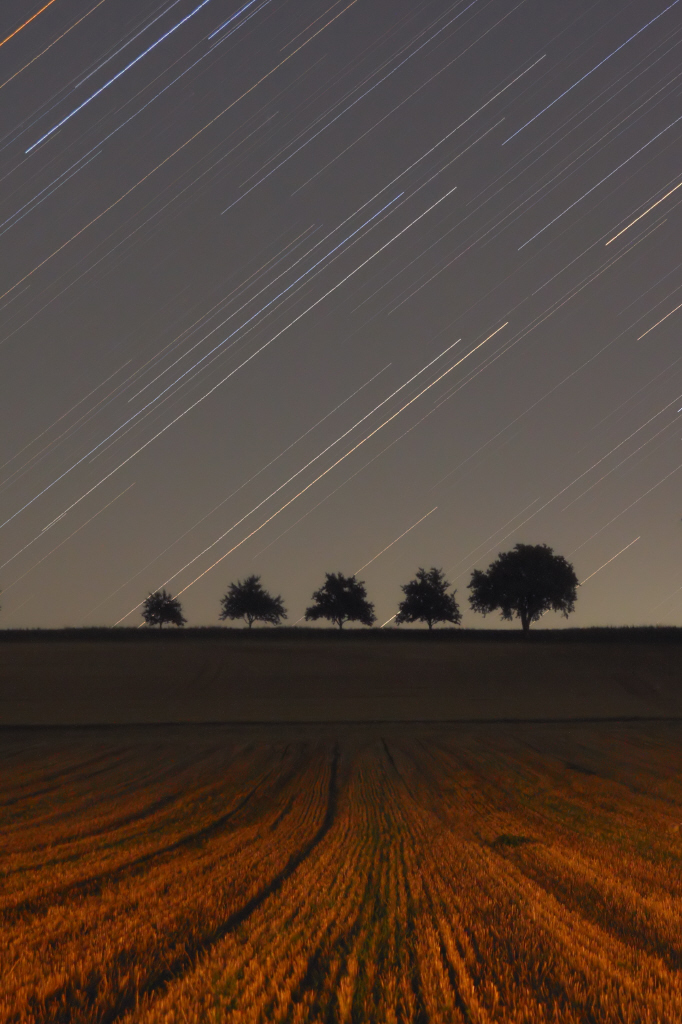
"Harvest Time" is a stack 38 individual frames, each of 60 seconds exposure time ~ © Herbert Raab
"This group of trees is located not far away from the place where I live," says Mr. Raab. "I have passed these trees almost daily for years before I finally recognized that they would make a nice foreground for a star trails image." He used a Canon EOS 550D at ISO 1600, with a Tamron 17-50mm f/2.8 lens at 50mm, f/4.0.

"Twilight" is a panoramic image composed of three single exposures of 20 seconds each ~ © Herbert Raab
When bright planets align in the sky, Herbert feels it's always a great time to do some night photography. In this image, Venus and Jupiter form an eye-catching pair in the evening twilight. Some of the brightest stars in the sky appear left of the two planets, including Betelgeuse and Riegel in the constellation Orion, as well as Sirius, Procyon and Aldebaran. This composite pano was taken with a Canon EOS 550D at ISO 1600, and the Tokina 11mm lens @ f/4.0, with a Cokin P830 diffuser.

"River of Stars" over an alpine lake in Grebenzen-Zirbitzkogel (Styria, Austria) ~ © Herbert Raab
 The Milky Way is sometimes described as "a river of stars". In this picture, it looks as if a boat would be ready for a ride on that river of stars. In a dark, moonless night, the Milky Way can be a spectacular sight. "Unfortunately," laments Herbert, "An increasing number of people who live under light-polluted skies have never seen the Milky Way." This is a single, 60 second exposure, taken with a Canon EOS 550D, at ISO 3200, using a Sigma 10mm fisheye lens @ f/2.8.

Technique and Tools: "Interestingly, many people think that night images require heavy image processing. Actually, that is not the case. In most cases, some tweaks during the RAW-conversion is all I do --with color balance and noise reduction being the most important," says Raab. He uses Adobe Camera Raw as his main post processing software, with ImageStacker for stacking star trail images, and PTGui for blending panoramas. Other than his Canon EOS 550D (A.K.A. the Rebel T2i in the USA, and the EOS Kiss X4 in Japan), he finds his Tokina 11-16mm f/2.8 wide angle lens, with the Cokin P830 diffuser in front, as his most valuable pieces of equipment.

Balancing life and photography: Herbert considers being at the right place at the right time as his biggest challenge in doing TWAN photography. "Considering the facts that I have a full daytime job, a family with three small kids, and that the weather here in central Europe is not always very cooperative, every night I can spend under the stars is a small miracle by itself," reports Herbert.

TWAN photography giving balance to life: He has observed that watching the stars slowly move across the sky is a counterpart to the busy, fast-paced world around us. Herbert sometimes philosophies about the photons that have crossed the universe for hundreds or thousands of years, that are now captured by his camera. "Every time I look at those photos that I took in such a night, the calmness returns," he says.

More of Herbert Raab's photography can be found on his Flickr Photostream.

Monday, September 17, 2012

James Neeley: Capturing a Glimpse of the Divine

"Starry Night" near Arco, Idaho ~ © James Neeley
James Neeley likes all types of night photography including cityscapes, light painting, fireworks, and stars; however, high ISO Milky Way photography is foremost on his list. "I love the natural world. Add to that the fact that there are 100 billion stars in our galaxy and 100 billion galaxies out there, photographing just a small part of this amazing universe we live in gives me a glimpse of the divine."

"San Francisco Nights" ~ © James Neeley

 James is a serious-amateur photographer who lives in Idaho Falls, Idaho, and supports his family as a physician. He is best known to many for his HDR landscape photography and his Mountain High Workshops.

"Light Show" - Light painting Delicate Arch during the "Blue Hour" ~ © James Neeley
Neeley enjoys light painting some of his night landscapes. In the above photo, he found it a real balancing act between the ambient light which was decreasing rapidly and the artificial light he and the members of his photo group brought. Fortunately, one of the participants brought a powerful light which became affectionately known as "Big Bertha" and had enough output to light the arch against the twilight sky. (Note: this exact product seem to no longer be available, however a similar 18 million candle power, rechargable halogen spotlight is made by Cyclops.)

High ISO Milky Way Photography is a passion for James. "I [had] done some long exposure astrophotography with a dedicated, cooled CCD camera through a telescope. When the Nikon D3/D700 came out with the ability to shoot fairly low noise pictures at 6400 ISO, I jumped at the chance to try capturing the Milky Way."

However, the latest and the greatest isn't always the best for this style of night work. Neeley still prefers the Nikon D3s camera. "In my opinion this camera has the best high ISO performance, even just edging out the [new] D4."

"Going Deep" - Arches National Park ~ © James Neely
 One of the biggest challenges he faces is ambient light or light pollution. "When you shoot at ISO 6400, f2.8, for 30 sec. even the darkest sites show some ambient light. Only the true 'dark sites' have the quality of sky to not show much extraneous light."

Unprocessed version of "Going Deep" (compare with above image) ~ © James Neeley
Image Enhancing: James doesn't do anything special except Photoshop CS6 for processing. The above photo is an unprocessed image. Processing consisted only of increasing the contrast of the sky (which also darkens the sky and intensifies the color) and increasing the brightness of the foreground just a bit.

Noise Reduction: Here's some advice from James: "A low noise full frame sensor is important. The critical camera setting is to turn on long exposure noise reduction. The camera will then take a dark frame following the exposure for the same time as the exposure itself and then subtract the images to greatly reduce the noise and hot pixels.

Remember, I'm not only shooting a long exposure but high ISO (6400 or 12800). If you want a real shock turn off long exposure noise reduction and shoot a 30 sec. exposure at ISO 6400 in a dark room at a blank wall. Your camera, or any camera for that matter will show multiple hot pixels. For this type of photography you must use long exposure noise reduction or take a dark frame and do the subtraction later on in post."

For additional post-production noise reduction, James likes Neat Image.

More of James Neeley's photography is available at his blog and his Flickr photostream.