 |
| Delicate Arch by Florian Schultz ~ taken with the Nikon D600 @ ISO 3200 |
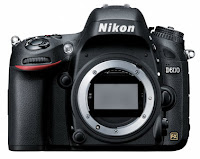 |
| Nikon D600 |
 |
| Canon EOS 6D |
Nikon and Canon recently announced two new entry-level, full-frame DSLR cameras that will significantly lower the cost for photographers wanting to enter into the field of doing quality, high ISO night photography. Both the
Nikon D600 (released on September 13, 2012) and the
Canon EOS 6D (to be released in December 2012) are priced in the U.S.A. at about $2,100. This makes the Nikon D600 about $900 less than the popular D800, and the Canon EOS 6D about $1,400 less than the 5D Mark III. Full-frame image sensors typically produce less image noise than smaller sensors because each pixel in the sensor array is larger and can
capture more light, producing a lower signal-to-noise ratio.
Nikon D600 Sensor is Comparable to the D800: The Nikon D600 has a new 24.3-megapixel FX-format CMOS sensor. Nikon says the camera's 14-bit A/D conversion and excellent signal-to-noise ratio enable it to produce images with low noise and wide dynamic range even at high ISO sensitivities. The D600 offers an ISO range of 100–6400, extendable up to 25,600.
Recent tests by DXO Labs rate the Nikon D600's sensor higher than the Nikon D3X, Nikon D4, Canon EOS 5D Mark III, and only slightly less than the Nikon D800! It will be interesting to see how well the Canon EOS 6D performs in these same tests after its release in December. (I agree with DxO's conclusion about the D600's sensor performing just slightly below the D800, but I'm not sure I agree that both sensors perform better than the Canon 5D Mark III. This leads me to the belief that the Canon 6D sensor may actually perform better than the Nikon D600 when all the tests are in (see below)).
 |
| This shows cropped detail of the top photo (click for an enlargement at 100%) |
|
Examine the Results for Yourself: This Nikon D600 photo was taken using a AF-S NIKKOR 14-24mm f/2.8G ED lens (zoomed to 15mm). The exposure was for 25 seconds @ f/2.8, ISO 3200, with the white balance color temperature set at 3,030 K. This image was taken in RAW and converted to JPEG with Capture NX 2 (you can download the
11.5 MB JPEG here). Note: the arch may appear soft (lacking in texture and detail), and that's probably because it is slightly out of focus, since the focus is set on infinity for the stars, and the f/2.8 aperture setting allows for very little depth of focus. Still, the sky has relatively little noise for an ISO of 3200! (
Click here to see other sample images from the Nikon D600.)
Nikon D600 VIDEO: Photographer, Florian Schultz, and his brother, share their experiences of testing the new Nikon D600 in a video called, "
Chasing the Light" --shot entirely with the D600. Be sure to also see, "The Making of Chasing the Light" --two brothers on a road trip, in an old pick-up truck! (I was intrigued to learn that the D600 has a built-in
intervalometer, and also has the ability to preview time lapse shots as a video sequence!)
Nikon D600 Preview: For the best hands-on preview
go to this Digital Photograpy Review.
Canon EOS 6D Preview: Because the 6D will not be released until December, there is little information available about it at the moment. For the best hands-on preview of the Canon EOS 6D, with key specs compared to the Canon EOS 5D Mark III and Nikon D600,
go to this Digital Photograpy Review.
Lens Compatibility: If you are currently using a Canon camera with an APS-C size sensor and LF-S lenses, you'll also have to upgrade to LF lenses, since the LF-S lenses do not provide full-frame sensor coverage. However, the Nikon D600 FX-format camera does offers support for the complete DX NIKKOR lens lineup (with DX lenses, the camera automatically switches to a 10.5MP DX-format crop mode). One must use FX NIKKOR lenses to take advantage of the camera's full 24.3-million pixels.
My Opinion: Overall, there are several specification on the Nikon side that out-weigh the Canon specs. However, this blog is about night photography and the benefits of low noise at high ISO's. I think either camera is going to be a smash hit for photographers wanting the higher dynamic range and lower noise of a full-frame sensor. Although the Nikon is the first entry-level full-frame camera out of the gate and with a lot of hype,
I think time may show that the image quality of the Canon EOS 6D to be superior at higher ISO's. There are at least two factors that lead me to this belief:
Number One: The default standard ISO range on the Nikon D600 is 100 to 6400, whereas the Canon EOS 6D has a standard ISO range of 100 to 25600, which is two stops greater. This would indicate that the Canon has superior noise control and a higher real life dynamic range.
Number Two: Tests from other sources lead me to believe that the DxOMark Sensor Scores may not be totally reliable (as several others have commented on the DxO website). For instance, they give an overall sensor score of 94 to the Nikon D600, just one point below the Nikon D800's score of 95; and they give the Canon EOS 5D Mark III a dismal score of 81, just two points above the older Mark II's score of 79.
 |
| Test pattern at Digital Photography Review (I choose the "BA" area from the bottle of Baileys liquor) |
The best comparison test I've found comes from
Digital Photography Review. When you take their test chart and compare the original Nikon D600 image file @ ISO 100 with three other images taken at ISO 6400, you'll notice that the Canon EOS 5D Mark III is closer to the ISO 100 image than the other two, followed by the Nikon D800, with the Nikon D600 coming in last. Both the chroma and the luminance noise are higher in the Nikon images, especially in the shadow areas (some would say the D800 chroma noise is worse than the D600). Yet DxO rates both camera sensors considerably higher than the Mark III.
It is my opinion that the Canon EOS 6D sensor will be close to the same quality as the Mark III sensor (just as the D600 is close the quality of the D800), and will therefore surpass the sensor quality of the Nikon D600. (Click to enlarge the image below.)
 |
| Choose any 3 cameras you want to compare. I chose these and an ISO of 6400 (top left is the ISO 100 control) |
Another Indicator To My Above Conclusion: The size of the above JPEG files also indicate the noise quality of the images. We all know that noisier files do not compress as well (lower compression rates). For instance, the Nikon D600 JPEG control image (at ISO 100) is 11.0MB, compared to 14.5MB for the ISO 6400 JPEG file. If you do the numbers below, you can see that the Mark III has the least noise, (because its JPEG file has the highest compression rate), followed by the D800, with the D600 trailing dead last:
CAMERA FILE PIXEL SIZE UNCOMPRESSED / COMPRESSED COMPRESSION RATIO
Canon 5D Mk3 file: 5760 x 3840 pixels = 63.28MB / 8.4MB JPEG = 7.53:1 compression
Nikon D800 file: 7360 x 4912 pixels = 103.43MB / 18.8MB JPEG = 5.50:1 compression
Nikon D600 file: 6016 x 4016 pixels = 69.12MB / 14.5MB JPEG = 4.77:1 compression


