|
| An April Milk Way rises behind Delicate Arch, Arches National Park, Utah - foreground illuminated by Low Level Landscape (LLL) lighting. This very dim, filtered light panel was set up on a tripod down in the bowl. It was dimmed down until it matches starlight. You cannot even see it until your eyes dark-adapt. The dim light was left on for about an hour, while over 30 visitors from several nations were able to take similar photos, even though they were not part of my workshop group. (EXIF: Canon 5DM3, Rokinon 24mm f/1.4, 13 sec, f/2.0, ISO 5000) © Royce Bair |
April 23, 2018 UPDATE: In 2017, three national parks (Arches, Canyonlands and Grand Teton) banned light painting, and there was even talk of banning all night photography. However, due to the lobbying and educational efforts of myself, Wayne Pinkston and many others, Arches, Canyonlands and Natural Bridges have now adopted the Low Level Lighting techniques that we pioneered as an approved standard for commercial Still Photography Instruction (workshops) within these parks! Standard light painting (described below in #16) is still banned, but LLL is allowed:
20. Light Panel - Using a low level light panel that emits extremely dim constant lighting during a nighttime photographic exposure is an approved method for lighting the landscape at night.Thank You! Wayne and I would like to thank all who have adopted our less obtrusive LLL techniques and promoted these methods to others. This thanks also goes to the great people at the National Park Service, who were willing to consider and modify their regulations. Together, we have made a difference that will help thousands to better enjoy the landscape and the night sky!
Grand Teton continues to ban all uses of artificial lighting at night, no matter the type (light painting or Low Level Lighting). The purpose of this restriction, claims the park superintendent, is to protect the wildlife. Night photography is still allowed, and headlamps are permitted by night photographers to help them get to and from their shooting locations (albeit, headlamps can be over 100 times brighter than LLL). It should be noted that unlike Arches, Canyonlands and Natural Bridges, Grand Teton's ban on artificial lighting applies to all photographers, whereas the aforementioned parks only placed their lighting restrictions on commercial workshops.
- - -
ORIGINAL POST ~ Dateline: January 12, 2017
Will All Night Photography Be Banned in Arches and Canyonlands National Parks? Beginning this year, no light painting will be allowed to take place within Arches and Canyonlands by commercial photo workshop groups; and starting in 2018, it is very possible that no night photography will be allowed by participants of these photo workshops within the two parks. Currently, this ruling applies only to Commercial Use Authorization (CUA) permit holders and their photography workshop groups. It does not (yet) apply to private individuals and amateur photographers.
16. Light painting – Light painting activities are not authorized under this authorization. Light painting, or light drawing, is a photographic technique in which exposures are made by moving a hand-held light source while taking a long exposure photograph, either to illuminate a subject or to shine a point of light directly at the camera, or by moving the camera itself during exposure. [APPENDIX SPECIAL PARK CONDITIONS - ARCHES NATIONAL PARK & CANYONLANDS NATIONAL PARK - Still Photography Instruction]Earlier this month, all night photography had been banned within the two parks for CUA permit holders and their photo workshop groups. However, after numerous protests from operators, who already had scheduled workshops in place, Concessions Management Specialist, Michael Hill, lifted the ban for the current 2017 season, but not the ban on light painting. In an email to all Still Photography Instruction CUA permit holders, Michael wrote on January 5, 2017:
Some folks have voiced no concern about the change, while a few others stated that all they do is night photography and that change would be devastating. ...For 2017 we will continue to allow night use in the Still Photography Instruction CUA for Canyonlands and Arches, as we have done in the past. Light painting, however has been an issue with our park nighttime visitors, and we still feel that does not have a commercial place in the park. …For 2018 I am open for dialogue if that night use will continue. Feel free to email me your comments.
 |
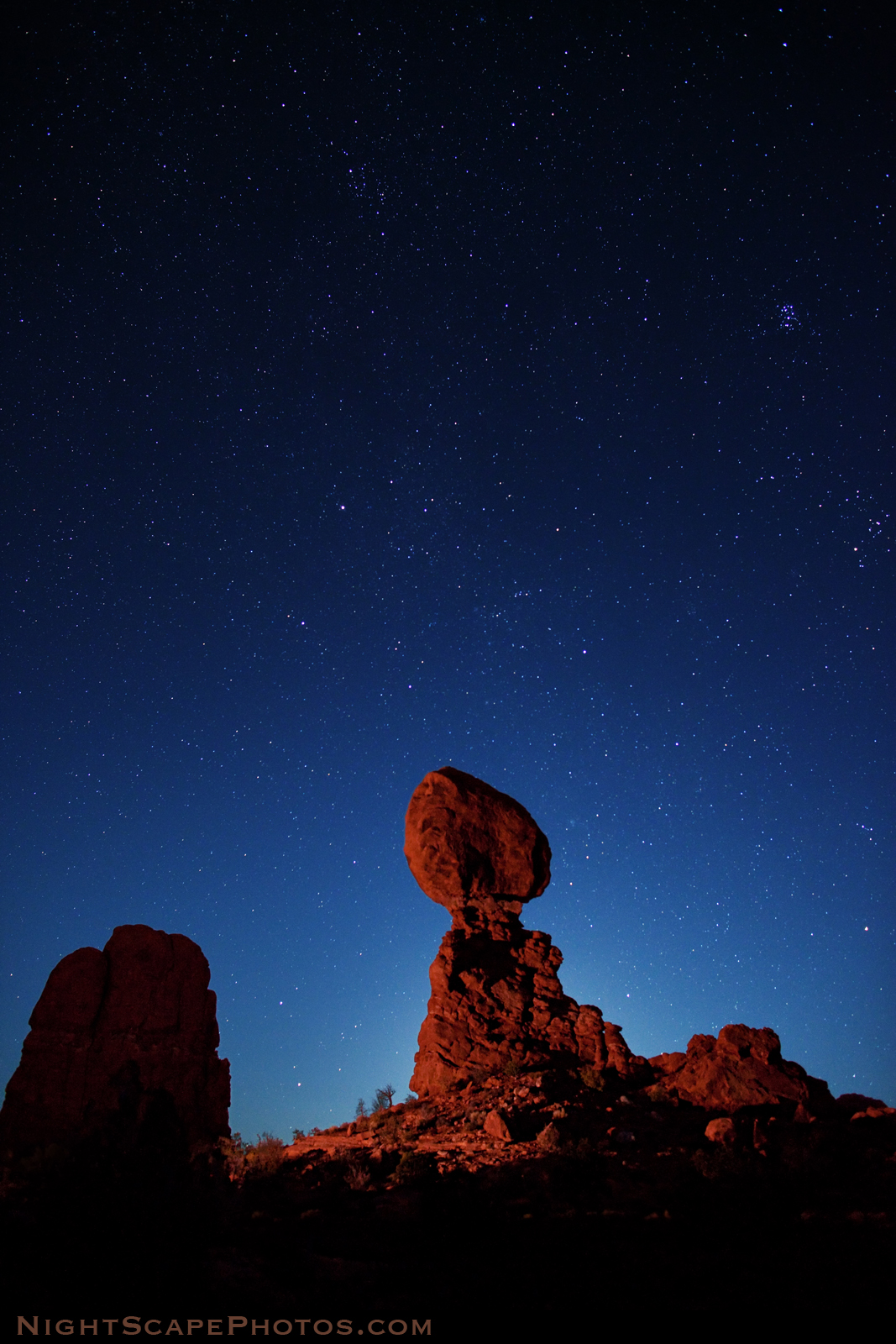
| Balance Rock stands only a few hundred feet from a busy park road. It is a very difficult formation to photograph at night because of all the car headlights that rake across it. However, at about about 2:00am on some Spring mornings, the traffic does diminish and one can capture the Milky Way rising above the horizon. (EXIF: Canon 5DM3, Rokinon 24mm f/1.4, 13 sec, f/2.0, ISO 5000, using LLL lighting.) © Royce Bair |
Could a future ban affect ALL photographers? It is not clear if a possible ban on all night photography will begin in 2018 just for Still Photography Instruction CUA permit holders, or if this ban will be for all photographers. Currently, Guided Interpretive Day Hiking within the two parks is already restricted to daylight and twilight hours:
36. Area Use – This authorization is applicable only for the use of the area, term, and conditions designated herein. The area(s) authorized for use under this authorization must be left in substantially the same condition as it was prior to the activities authorized herein. Only 2wd roads are authorized for use.Increasing Park Visitation and undesirable activities in the park. Michael Hill, explained park managements reasons for the changes in the same email letter to CUA permit holders:
**Approved use starts 1/2 hours before sunrise and ends 1/2 hours after sunset. This does not include travel time.**
Managing the parks here are complex, and have ever changing issues to manage.
If you have followed the news you would understand the explosive use of this area has changed a lot in and out side of the parks here. Technology as well has impacted how we manage the parks. In those 8 years we have gone from 24 to 260 CUAs. Our park visitation has increased to where we need to change how we manage the visitors, as well as commercial services.
It is our mandate to balance protecting the park resource and providing the enjoyment for park visitors. We have to balance the commercial use of a park in regards to services that are appropriate and/or necessary, in regards to the above statement. Commercial use in a park is a privilege.
Regarding night photography instruction, you don't need Arches to teach night photography. Teaching night photography can be accomplished in many areas outside of the National Parks here.
Regarding light painting in Arches National Park. We have determined that as not a desired activity in the park when, we have visitors (not photographers) complain about it, and some of those visitors just leave the park as they don't know what is going on.Are Additional Night Photography Bans Coming? As park visitation increases in all the national parks, we may expect to see similar bans on night photography in other parks. Fox News recently reported that Utah's Zion National Park is now experiencing too many visitors, even in the winter off-season.
Is "Light Painting" Getting a Bad Rap?
That depends on how one defines "light Painting." If it is defined the way park regulations are written above as, "...moving a hand-held light source while taking a long exposure photograph," then maybe it deserves the bad publicity. Usually, these lights are powerful flashlights, headlamps or even spotlights that are being waved around natural formations to illuminate them. The lights are so bright, they can only be left on for a few seconds during the long camera time exposure that is necessary to record the starry night sky. The on and off flashing of these bright lights is ruining to one's night vision, and is very annoying to visitors (especially non-photographers) who are there to enjoy the night sky at a unique dark sky location. Most of these lights also have a very bluish color rendition, which also adversely effects night vision. Remember, many of the national parks have been promoting the slogan, "Half the park is after dark," and most of these nocturnal visitors are coming to see the stars, not your light painting!
The better way to light: More responsible photographers are beginning to use stationary, Low Level Landscape lighting (LLL). These very dim, filtered light panel care set up on a tripods and dimmed down until they matches starlight. They are so dim one cannot even see their effect until ones eyes dark-adapt.
Share and share alike. In the top image, I was never able to get a decent photo because a bus tour of about 30 foreign photographers came and they would not shut off their headlamps and flashlights, even for 30 seconds. They wanted it all to themselves. “You Americans think you own the national parks,” said the tour leader. I checked the next day, and the park had no record of a permit for them. In the bottom photo (2 years later), dozens of photographers shared my lighting set up and even my shooting position. One of those was a talented photographer from India, Manish Mamtani.
Continuing the Discussion...
To see what others are saying about the light painting restrictions and the possibility of a complete ban on all night photography, beginning in 2018, check out this post on Ben Coffman's Facebook page.
Fellow photo workshop instructor, Brad Goldpaint, had this to say in that Facebook post, after a lengthy telephone conversation with park Concessions Management Specialist, Michael Hill...
Mike mentioned the issues he’s been facing in the park(s): Too many crowds/busses, too many CUAs, not enough staff, and too many complaints from nighttime photographic activity. He mentioned a number of examples which led to this abrupt change. A couple of these examples stood out to me that I’m sure some of you can relate to:

Popular Links: How to Shoot the Milky Way • Post Processing NightScapes • Workshops and PhotoWalks • Tutorials and Tips • Overcoming Lens Coma • Video Hangout with my Friends

That depends on how one defines "light Painting." If it is defined the way park regulations are written above as, "...moving a hand-held light source while taking a long exposure photograph," then maybe it deserves the bad publicity. Usually, these lights are powerful flashlights, headlamps or even spotlights that are being waved around natural formations to illuminate them. The lights are so bright, they can only be left on for a few seconds during the long camera time exposure that is necessary to record the starry night sky. The on and off flashing of these bright lights is ruining to one's night vision, and is very annoying to visitors (especially non-photographers) who are there to enjoy the night sky at a unique dark sky location. Most of these lights also have a very bluish color rendition, which also adversely effects night vision. Remember, many of the national parks have been promoting the slogan, "Half the park is after dark," and most of these nocturnal visitors are coming to see the stars, not your light painting!
The better way to light: More responsible photographers are beginning to use stationary, Low Level Landscape lighting (LLL). These very dim, filtered light panel care set up on a tripods and dimmed down until they matches starlight. They are so dim one cannot even see their effect until ones eyes dark-adapt.
 |
| "Headlamp Intrusion" at Mesa Arch - Canyonlands National Park. The top photo shows headlamp intrusion from a hiker about 100 yards behind me, through the trees and brush. The bottom photo has the same LLL (low level landscape) lighting as the top photo, but did not have the headlamp intrusion from behind. This should give one an idea of how dim and subtle LLL lighting is. Because this type of lighting is on for the whole astronomical exposure, it must match or be just slightly brighter than the intensity of starlight! In the top photo, the hiker's headlamp was only on for a few seconds of the whole 25-second time exposure, yet its estimated 150 lumens brightness (even from 300 feet away) completely overpowers my LLL lighting. (EXIF: Canon 5DM3, Tokina 15-30mm @ 15mm, 25 sec, f/2.8, ISO 6400) © Royce Bair |
Share and share alike. In the top image, I was never able to get a decent photo because a bus tour of about 30 foreign photographers came and they would not shut off their headlamps and flashlights, even for 30 seconds. They wanted it all to themselves. “You Americans think you own the national parks,” said the tour leader. I checked the next day, and the park had no record of a permit for them. In the bottom photo (2 years later), dozens of photographers shared my lighting set up and even my shooting position. One of those was a talented photographer from India, Manish Mamtani.
 |
| "Arch over an Arch" - Mesa Arch, Canyonlands Nattional Park, Utah. “This is a Milky Way panorama created by stacking and stitching about 56 images. I wanted to take this shot at Mesa Arch in Utah [for over] 4 years, and finally this year I was successful. I ran into Royce Bair …and he had set up some lights to light the foreground,” says Manish. © Manish Mamtani |
Continuing the Discussion...
To see what others are saying about the light painting restrictions and the possibility of a complete ban on all night photography, beginning in 2018, check out this post on Ben Coffman's Facebook page.
Fellow photo workshop instructor, Brad Goldpaint, had this to say in that Facebook post, after a lengthy telephone conversation with park Concessions Management Specialist, Michael Hill...
Mike mentioned the issues he’s been facing in the park(s): Too many crowds/busses, too many CUAs, not enough staff, and too many complaints from nighttime photographic activity. He mentioned a number of examples which led to this abrupt change. A couple of these examples stood out to me that I’m sure some of you can relate to:

- “Someone set up a tent under a popular arch, put a light inside of it, and then turned on three other flashlights in the area. A visitor approached the scene, thought there was a search and rescue underway, and decided to leave the area. We’ve had people sleeping under the arches, hiking off trail, vandalism, and it’s getting to the point where we have no way of controlling the massive amount of crowds.” Mike has a lot of experience and history with Arches. He told me back in the 80’s he could ride a bike throughout the entire park during a full moon and not see a single headlight throughout the entire night. Nowadays, he gets more and more complaints about people in the park at night, “doing things they shouldn’t be doing.” I couldn’t help but mention ‘the CUA holders I know are actually the ones who are protecting, teaching, and leading by example to help keep a close eye on what transpires at night. If you remove the CUA holders, then it really is free reign on the park.’
- “Some things have gotten so bad I’ve had my sanitation crew threaten to quit. We have busloads of visitors coming from the other side of the ocean who have never used a pit toilet. Therefore, visitors and my crew have to pick up human feces. We’re actually installing visual diagrams to show visitors how to use pit toilets in hopes of preventing this issue from continuing to happen.”
- “We’ve had busses follow night photography workshops around and we don’t have the staff to keep them out of the area so the students can enjoy. The instructor will complain, but I don’t have the staff to control the massive amount of people.”
- “We were actually going to get rid of the entire ‘Still Photography CUA,’ but I fought to keep it. I did my best in trying to limit use during times we cannot monitor the park.”
Listening to Mike, I began to understand the issues he and the park are facing. It’s not what I wanted to hear, nor was this unexpected change handled in a reasonable manner, but something has to give and change is inevitable. Remember, “Commercial use in a park is a privilege and no one is guaranteed a CUA the following year.”
I’m happy to see we are allowed to teach an additional year in Arches & Canyonlands, but I believe it is critical for all current and future CUA holders to voice their opinions and ideas to formulate a sustainable solution for all parties affected so future generations can enjoy similar experiences we’ve been fortunate enough to have. As Mike H. said in his latest email, "For 2018 I am open for dialogue if that night use will continue. Feel free to email me your comments. I look forward to receiving them."
Followup: After I had a chance to discuss these issues with Brad, we both agree that Mike is in a tough situation and trying to do whatever he can to alleviate the problems of night use in the park. The problem, we believe, is park administration is blaming it on the “good guys.”
If only the CUA holders are banned from doing night photography in the parks, who is going to be there to report the non-permitted tour bus groups that lurk the parks at night?
Despite this, no light painting in Arches and Canyonlands is a restriction we can live with, if it will help reduce tension and heighten the dark sky experience for all visitors to these two parks.
Teaching Night Photography Ethics:
In an effort to educate the public on proper night photography ethics and Low Level Lighting (LLL) techniques, I have scheduled an entertaining and educational mini-seminar for March 14, 2014, called “Creating Natural NightScape Photographs.” This free event is sponsored by Adobe Systems, and will include socializing at the Viridian Event Center in West Jordan, Utah.
If only the CUA holders are banned from doing night photography in the parks, who is going to be there to report the non-permitted tour bus groups that lurk the parks at night?
Despite this, no light painting in Arches and Canyonlands is a restriction we can live with, if it will help reduce tension and heighten the dark sky experience for all visitors to these two parks.
Teaching Night Photography Ethics:
In an effort to educate the public on proper night photography ethics and Low Level Lighting (LLL) techniques, I have scheduled an entertaining and educational mini-seminar for March 14, 2014, called “Creating Natural NightScape Photographs.” This free event is sponsored by Adobe Systems, and will include socializing at the Viridian Event Center in West Jordan, Utah.
- - -
Popular Links: How to Shoot the Milky Way • Post Processing NightScapes • Workshops and PhotoWalks • Tutorials and Tips • Overcoming Lens Coma • Video Hangout with my Friends