Share:

Saturday, December 29, 2012

POTW: 'Milky Way' by Andrey Shumilin

 "Milky Way" by Andrey Shumilin (click on image to enlarge)
Our Photo of the Week (POTW) was taken by Russian photographer, Andrey Shumilin. Andrey used a Nikon D700 with a Nikkor 14-24mm f/2.8, zoomed to 14mm. His base exposure for the sky was f/2.8 for 30 seconds @ ISO 3200, and three bracketed exposures for the ground, using an ISO of 200. The foreground was also enhanced with the use of an LED flashlight. All exposures were done with the camera on a stationary tripod.

Technique: (The following was translated from Russian to English, so please bear with us.) Andrey stacked the 12 sky shots by layers in Photoshop. He then applied Auto-alignment to the stars. (The ground objects were temporarily closed off with the use of an unsharp mask, otherwise the alignment will occur on ground objects, and not by the stars.)

Blending mode of the second from the bottom layer was changed to Screen, and merged down. Similarly, pairwise other layers have been processed. As a result, [he] got six brighter layers where the stars were coincide. [The] next step — setting layer's Opacity: the bottom layer - Opacity 100%, second from the bottom - 50%, the next one - 33%, then 25%, 20%, and the top layer - 16%. Then the layers were merged. The ground was then added the final image from three bracketed shots.

Satisfaction: "As a result, I got a picture with virtually no noise," says Andrey". "It allowed [me to] greatly increase the saturation and contrast without [a] catastrophic increase in the noise level."

More of Andrey Shumilin's photography can be seen at his 1x website.

Thursday, December 27, 2012

TOTW: Flashlights for Light Painting

Today, I'm starting a new weekly blog feature: Tool of the Week (TOTW). This will include everything from equipment, gadgets, hardware, software, applications, website instruction, or any tool that helps night photographers take better photos.

David Kingham started this discussion about flashlights a few weeks ago when he asked other night shooters to share what they used for light painting. He shared his own night chaser, the UltraStinger Xenon flashlight by Streamlight ($195 list). Kingham reports, "This is the main light I've been using for a few years now. I love the xeon light, but this thing cranks out too much light most of the time." The UltraStinger is the brightest Streamlight flashlight available, putting out to 35,000 candela (peak beam intensity), or 230 lumens.

About a month ago we did a feature on Neale Smithies (a.k.a. "LED Eddie"). Neale's signature LED flashlight is 7-LED "torch" made by LED Lenser, and known as the X21R Flashlight ($600 list). The 7-LED reflector pattern of this flashlight is used as Neale's watermark on his website gallery. With up to 1600 lumens, the rechargeable X21R may be the most powerful handheld LED on the market. It's Advanced Focus System allows the light to be directed into a far-reaching spot (up to 1900-foot beam distance), or as a flood light.
 
Lighting set-up for Hole in the Wall Arch - Arches N.P., Utah USA ~ © Royce Bair (click to see more info)
Click to enlarge
Although much of my light painting is actually done with large, stationary halogen lights and studio strobes (i.e. in the above light set-up), I do employ the use of flashlights on smaller landscape features —like the orange (gel filter) glow in this 30-foot diameter hole you see to the right (which is the hole you see in the above photo). I found a company in Portland, Oregon called Coast Products that makes a line of high performance LED flashlights that are very similar to the LED Lenser line, but about one-half the cost. Their 1317 lumens HP21 ($295 list) is similar in design to LED Lenser's X21 model, but half the price. Coast lights are well made, and they have beam focusing optics (giving you a flood beam and a Bulls-Eye spot) similar to the LED Lenser brand, and most have a high and low power cycle switch.

I have two of their flashlights: the HP14 and the larger HP17. The Coast HP17 ($117 list) uses three D-cell alkaline batteries and gives me both a 615 lumens output (almost as much as a 60-watt incandescent lightbulb), and a low output of 64 lumens. This heavy-duty light will run for over 15 hours at full power. At just under 2 pounds (with batteries), it also makes a good night club when traveling in rough neighborhoods. The more compact Coast HP14 ($72 list) uses four AA alkaline batteries, yet still puts out 339 lumens and 56 lumins in the low setting. When I'm shooting at ISO 6400, in order to get the stars in one 30-second exposure, the even the low output setting is sufficient power to paint some close objects.

(Note: all of these flashlights can be purchased online via mail order houses at substantially lower prices.)

Royce Bair is the editor of this blog and the photographer of the above images. Here is my gallery of NightScape images. My schedule of workshops, tutorials, and other events is available here.

Monday, December 17, 2012

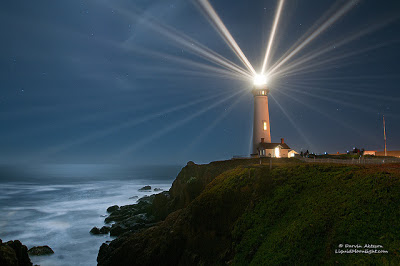
POTW: 'Return to Pigeon Point Lighthouse' by Darvin Atkeson

"Return to Pigeon Point Lighthouse - 138th Anniversary" ~ © Darvin Atkeson (click on image for a larger view)
Our Photo of the Week was taken by Darvin Atkeson at the Pigeon Point Lighthouse, west of San Jose, California. The question most often asked when people see this photo is, "Are the beams real?" Darvin assures us that this is how it really looked on November 13, 2010 when they stopped the rotation of the Fresnel lens for the attending photographers. Darvin took this photo with a Nikon D300, using a Nikkor 10-14mm f/3.5-4.5 @ f/4.0. The exposure was for 48 seconds, at ISO 100. There is no Photoshop work on this image other than adjustment to the levels.

"The waves sparkled in the moonlight as they crashed upon the rocks below my vantage point. As always, the lighting of Pigeon Point Lighthouse annual lighting was a stellar event. The evening was warm and clear with just enough ocean mist to get the brilliant beams of the lighthouse to absolutely glow," reports Atkeson.

Challenges: High contrast is normally an issue when photographing lighthouses at night. "It took me four years attending the event to get this shot with the moon helping out the sky and sea foam, but still getting the stars," says Darvin.

Satisfaction: Hundreds of photographers show up but only a few stay till the very end when this shot was taken. It's cold, wet, windy and chills one to the bone.

"I wanted to capture the mood of the event," says Darvin. "The 24 beams of light are so intense and travel to the horizon. I had envisioned the shot years earlier but didn't have the necessary camera to do the job properly. It would take four more visits to the event to get the same look as [the] previous years were foggy. It was a pure joy to see and then have the image actually look as it appeared [when] viewing the event."

More of Darvin Atkeson's photography can be seen at his Flickr and 500px websites.

Editor's Note: The Pigeon Point Lighthouse had it's 140th anniversary on November 17, 2012. The anniversary marks the first lighting of the lighthouse’s magnificent Fresnel lens on November 15, 1872. Most anniversary celebrations in past years have included a once-a-year lighting of the Fresnel lens. That won’t happen for some time because a year ago the lens was removed from the lighthouse for safe keeping so the tower could be repaired. The lens will be returned to the tower when the restoration is completed.

Friday, December 7, 2012

POTW: 'Nighttime Rainbow Over The Rockies' by Mike Berenson

"Nighttime Rainbow Over The Rockies" © Mike Berenson (click on image for a larger view)
This panoramic Photo of the Week was taken by Mike Berenson from a small pond near Loveland Pass, west of Denver, Colorado. It shows the summer Milky Way stretching from horizon to horizon across the mountains of the Continental Divide, with Denver light pollution glowing just above the mountains. The amber color is partially due to smoke from recent wildfires. Mike captured this panorama this past June with his new Nikon D800, using a Rokinon 24mm f/1.4 lens.

Technique: This panorama is made up of 16 vertical images, each exposed at f/1.8 for 20 seconds, ISO 6400. The images were stitched together with a software called PTGui.

Challenges: One of Mike's biggest challenges was getting just enough detail on the mountains and foreground. He had tried to shoot the same location under darker skies (without a moon), but found that to get it just right, he really needed moonlight —but not too bright. He choose a day in late June, with a quarter moon, that worked perfectly.

Berenson also feels the shadow detail was improved by the low-light capabilities of his new D800, but the larger files of the D800 also created a computer challenge when having to process and combine 16 images! "This may not have been the best time to test the new beast, but I didn't mind," laughs Mike.

Mike had shot at this location before, only to be disappointed. In order to make this image work, a lot of conditions he had little control over had to all come together: Clear skies, the right amount of moonlight, and calm winds so he could get good reflections on the pond. "I [also] needed the pond to be thawed (sounds obvious, huh), but that seemed to take forever —with a few wasted trips that I just chalked up to scouting," whips Mike.

Satisfaction: One of the goals Mike had was capturing the reflected stars on the pond from a little bit of distance. He had been taking plenty of up-close reflections; but for this location, he really wanted to show the pond as a smaller component of the foreground. "...almost like it's at the foot of Grizzly Peak, even though it's really across the valley," explains Berenson.

"When I first saw the results in a stitched panorama, I had a huge smile," says Mike. "It's difficult to appreciate the grand view of the sky and the curving milky way with each individual image in a panoramic sequence. But when you put it all together, it becomes so much more than the sum of the parts."

More of Mike Berenson's photography can be seen at his Colorado Captures website and his Flickr photostream.

Saturday, December 1, 2012

POTW: 'Encoded transmissions' by LED Eddie

"Encoded transmissions" ~ © Neale Smithies (click on image for a larger view)
Our featured Photo of the Week was taken at the Cobbet Hill Earth Station in Pirbright Surrey, UK. Neale Smithies is a British light painting artist and nocturnal photographer known as "LED Eddie." Smithies used a Nikon D300s with a Tokina 11-16mm f/2.8 lens, and shot at 13mm.

Technique: The grey dish was strobed three times with an orange-gelled Nikon SB-600 Speedlight at 1/2 power with the lens and camera set to f/5.6 @ ISO 400. Smithies then made about 180 30-second exposures @ f/5.6 (ISO 800) for the 90-minute star trails (exposures combined in Starstax). Both the star exposures and the dish were photographed with the same 2500ยบ Kelvin White Balance, but the orange gel placed the dish at the opposite end of the Kelvin balance.

Challenges: "After an unsuccessful trip to shoot dishes at GCHQ in Cornwall, I finally managed to gain official access to a high security site containing more satellite dishes than you could shake a stick at," says Smithies. "This particular dish is the size of a small house and the site owners kindly offered to switch off all the security lighting whilst I was there."

Neale's biggest challenge was getting the polaris lined up with the point of the dish, which can be very difficult when using a wide angle lens. "I used a laser [5mw green laser pointer] to frame up and then take a few test exposures at 6400 ISO to check for correct alignment."

Satisfaction: "I wanted to create an image that appeared to be beaming out radio waves into space," says Neales. "It is something I have tried on a few occasions but have always been beaten by cloud or ground mist. I couldn't have wished for a better result when the final image emerged from Starstax."

More of LED Eddie's photography can be seen at his Flickr photostream and his website.

Editor's Note: We plan to do a feature on "LED Eddie's" work in the future. Neale's signature LED flashlight is 7-LED "torch" made by LED Lenser, and known as the X21R Flashlight. The 7-LED reflector pattern of this flashlight is used as Neale's watermark on his website gallery. With up to 1600 lumens, the rechargeable X21R may be the most powerful handheld LED on the market. It's Advanced Focus System allows the light to be directed into a far-reaching spot (up to 1900-foot beam distance), or as a flood light.